For many teams working in Jira, the early stages of test design remain a significant constraint. Requirements may move quickly through refinement and development—often accelerated further by AI—but translating them into structured, high-quality test cases is still labour-intensive. Testers often repeat similar patterns of work or compensate for inconsistencies across contributors. The result is predictable: development accelerates while test design struggles to keep pace. The VibeTester AI Test Case Generator for Jira addresses this gap by offering a scalable, consistent way to produce test artefacts without removing the tester’s judgement or oversight.
Even with well-established processes, the quality and completeness of test cases can vary considerably between testers. One tester may focus on functional flow, another on edge cases, another on negative scenarios, and another on data-driven conditions. The result is unavoidable inconsistency, which creates downstream inefficiencies in UAT, SIT, regression cycles and automation. Test managers know this problem all too well: the team is capable, the methodology is sound, yet the test case library still feels uneven.
This is partly why so many organisations have experimented with AI over the past 18 months. The promise seems clear enough: AI can read user stories and acceptance criteria, and it should be able to generate test cases quickly. And indeed, many teams are already using general-purpose AI tools to draft test cases before pasting them back into Jira or their test management tool. The trouble is that these basic AI workflows are neither scalable nor consistent. Testers rely on their own prompts, their own habits and their own interpretation of the requirements. Copy-and-paste processes introduce errors, and the quality of the AI output varies significantly from prompt to prompt and person to person.
The challenge is not whether AI can generate test cases. It already can. The real challenge is whether it can generate consistently structured, testable and reviewable cases inside Jira itself, aligned to the organisation’s standards, and without creating more work for testers who are already stretched.
This is where VibeTester AI test case generator for Jira – provides a more mature and reliable approach. Unlike tools that simply send your Jira text to a single AI prompt, VibeTester introduces an agentic AI workflow directly within Jira. It uses a coordinated sequence of Authoring, Critique and Rewriter agents, designed to produce higher-quality, more comprehensive and more consistent test cases. Crucially, the tester remains fully in control. All generated tests can be reviewed, edited and validated before being imported into Jira, Xray or Zephyr, ensuring that human-in-the-loop evaluation is preserved at every stage.
Why Manual Test Case Design in Jira Creates Bottlenecks
Software delivery has already been accelerating for years, but the rapid introduction of AI into development workflows has pushed the pace further still. Developers can now generate code, refine designs and experiment with alternatives far faster than before. The effect is clear: more change, more features and more variants flowing into Jira in less time.
Test functions, however, often remain constrained by largely manual test case design. Stories are raised, refined and accepted, yet the moment they reach test design, progress slows. Testers spend large parts of their day rewriting familiar patterns of test cases, translating user stories into steps, and trying to keep test suites coherent across projects and releases. Even with good practice in place, this manual work simply does not scale at the same rate as AI-assisted development.
The bottleneck does not arise from a lack of tester skill. It arises because manual test case creation is intrinsically slow, repetitive and prone to variation. Different testers will naturally emphasise different aspects of a feature: one might focus on core flows, another on edge cases, another on data combinations. Without a common design framework, the resulting test library reflects those individual differences. Over time, that variability manifests as gaps in coverage, uneven documentation and friction in UAT, SIT and regression cycles.
As AI becomes more common in development, there is a growing temptation to “let AI generate and automate everything” and to assume that speed alone will solve the problem. In reality, that approach simply shifts the bottleneck. Large volumes of AI-generated tests, automated without clear guidance on what should be automated and at which levels, can quickly create a monolithic test suite that is difficult to understand and even harder to maintain. Even with the best intentions, teams can end up with an automation estate that looks impressive in size but offers poor practical value.
The real requirement, then, is not just faster test generation. It is faster generation that still respects the test team’s overall approach to automation and quality. AI needs to accelerate the design work inside Jira, not bypass the judgement and discipline that experienced testers bring to deciding what should be tested, and how.
The Hidden Risk of “Let AI Automate Everything”
As AI becomes more common in development and testing, there is a growing misconception that the most efficient approach is simply to let AI generate all the test cases, automate them and push them directly into execution. On the surface, this looks attractive: it promises speed, scale and reduced manual effort. However, teams that follow this path without discipline tend to discover a second, often more damaging bottleneck later on.
The problem is straightforward: AI can generate a very large number of test cases very quickly, but rapid test creation is not the same as effective testing. If a team does not define what kinds of tests they want, at which levels, and for what purpose, AI will quite happily produce an unfiltered mix of functional, boundary, negative and exploratory scenarios. Some of these may be genuinely useful; others may overlap, contradict, or add little value. Without a clear framework, the test suite expands rapidly but loses coherence.
This becomes even more challenging once automation enters the picture. If every AI-generated test case is pushed directly into an automation pipeline, you can easily end up with a monolithic automation suite—large, fragile and difficult to maintain. Even with advanced tooling, maintaining thousands of loosely related test flows consumes more time than it saves. A poorly structured automation suite slows feedback cycles, obscures signal-to-noise ratios and increases triage workload when failures occur. AI does not solve this by itself; in fact, without the appropriate guardrails, it can accelerate teams into precisely the problems they were trying to avoid.
Experienced test leads know the truth here: deciding what to automate is just as important as knowing how to automate. Not every scenario benefits from UI automation. Not every boundary condition needs a scripted check. Some flows belong at the API layer; others should remain exploratory. Successful test automation has always relied on making deliberate choices, and AI does not replace that judgement. It simply changes the nature of the work.
For AI-generated test cases to deliver real value, they must be created within a structure that testers understand and control. Drafts need to be reviewed, refined and selected based on relevance, stability and long-term maintainability. This is where human-in-the-loop validation becomes critical: testers validate the draft, adjust the phrasing, remove unnecessary scenarios and confirm that the remaining set aligns with the team’s overall automation approach.
In other words, the aim is not to let AI decide. The aim is to let AI accelerate the thinking, while testers remain in control of what is imported, maintained and, ultimately, automated.
Where VibeTester Is Especially Valuable in Real Teams
AI in testing is most effective when it solves practical, day-to-day problems rather than introducing new layers of complexity. In my experience, the value of a tool like VibeTester AI test case generator for Jira becomes most visible in teams facing one or more of the following pressures. These are not hypothetical scenarios; they are the patterns that appear across large organisations, multi-team programmes and fast-moving product groups.
1. Rapidly expanding product scope with continuous story churn
Many teams now see significant levels of story turnover: refinements late in the sprint, requirements shifting mid-build and additional edge cases being uncovered during development. When combined with AI-assisted coding, change volume increases even further.
Testers often find themselves maintaining test libraries that struggle to keep pace. VibeTester AI test case generator for Jira helps by generating or regenerating test cases directly from the updated Jira issue, pulling in the latest acceptance criteria, descriptions and supporting details. This reduces the gap between story change and test design, and it helps keep coverage aligned with the product’s evolving shape.
2. Teams with mixed levels of testing experience
Few organisations have the luxury of a uniformly senior test team. It is common to have a mix of junior testers, mid-level analysts, vendor resources and senior specialists. In such environments, test case quality typically varies.
VibeTester AI test case generator for Jira enables senior testers or test leads to define reusable templates and rules that set the standard. Junior testers can then generate test cases that follow that standard, with the agentic AI refining the language and structure. This reduces coaching overhead, improves consistency, and shortens the time it takes for less experienced testers to become productive.
3. Organisations needing to standardise quality across regions or suppliers
Multi-region programmes or vendor-delivered teams often struggle with alignment. Even when using the same tooling, the interpretation of requirements and the way test cases are written can differ significantly.
By providing a shared set of rules, templates and configurable prompts, VibeTester produces test cases that follow the same pattern regardless of who generates them. This supports cross-team consistency and reduces rework when scenarios move between regions, partners or internal squads.
4. Accelerating UAT and SIT test design
UAT and SIT phases often suffer from compressed timelines. Business users do not always have the capacity to write detailed scenarios, and integration testers are frequently pulled in multiple directions.
VibeTester helps generate initial scenario sets quickly, giving teams material they can refine rather than forcing them to start from a blank page. This is particularly effective when working with business testers who understand the domain well but are less familiar with writing structured test cases.
5. Teams trying to use BDD more systematically
BDD works when scenarios are written consistently using clear Given/When/Then structure. In reality, BDD libraries often become inconsistent over time. VibeTester’s agent-based generation supports clearer scenario construction and reduces the drift that makes BDD suites harder to automate.
How the VibeTester AI Test Case Generator for Jira Works Inside Your Workflow
The most important quality of any AI testing tool is how naturally it fits into existing workflows. VibeTester is designed to work entirely inside Jira, using the issue as the single source of truth. There is no need to copy content into external chat tools, maintain prompts separately, or manually synchronise changes. Everything is handled directly within the issue view, with the tester retaining full control over what is generated, reviewed and imported.
The workflow is divided into a few straightforward steps.
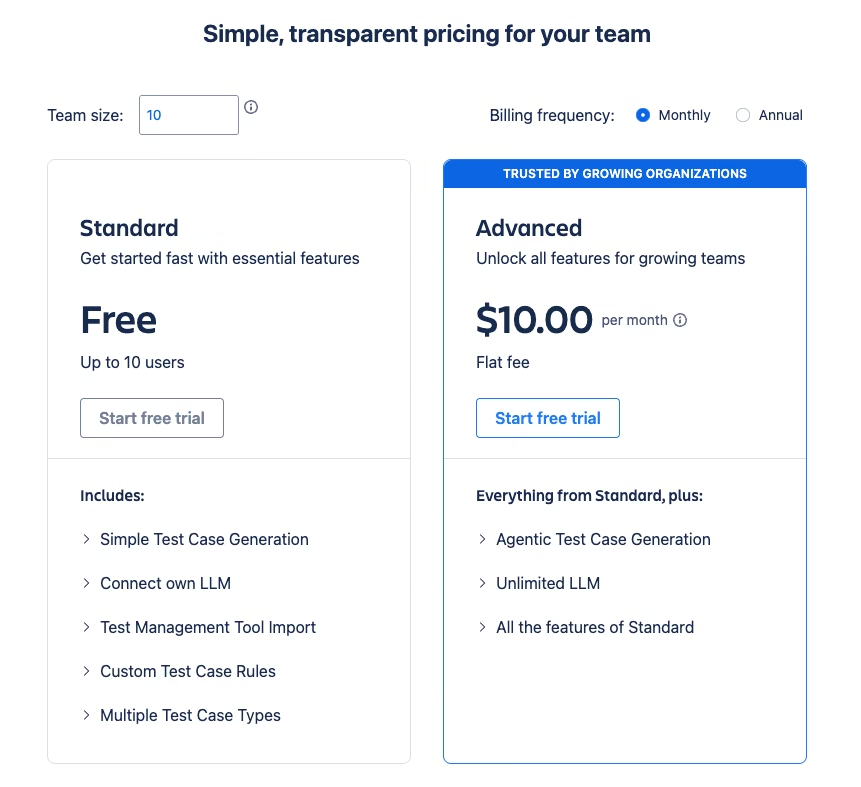
Selecting Standard or Advanced Mode at Installation
When the plug-in is installed for the first time, administrators choose between the Standard and Advanced configurations. The Standard configuration gives teams a single-model AI workflow, suitable for quick generation. The Advanced configuration unlocks the agentic model—Authoring, Critique and Rewriter agents—which provides refined, structured and more complete test cases. Both options support connecting your own LLM provider.
Configuring Test Case Rules and Templates
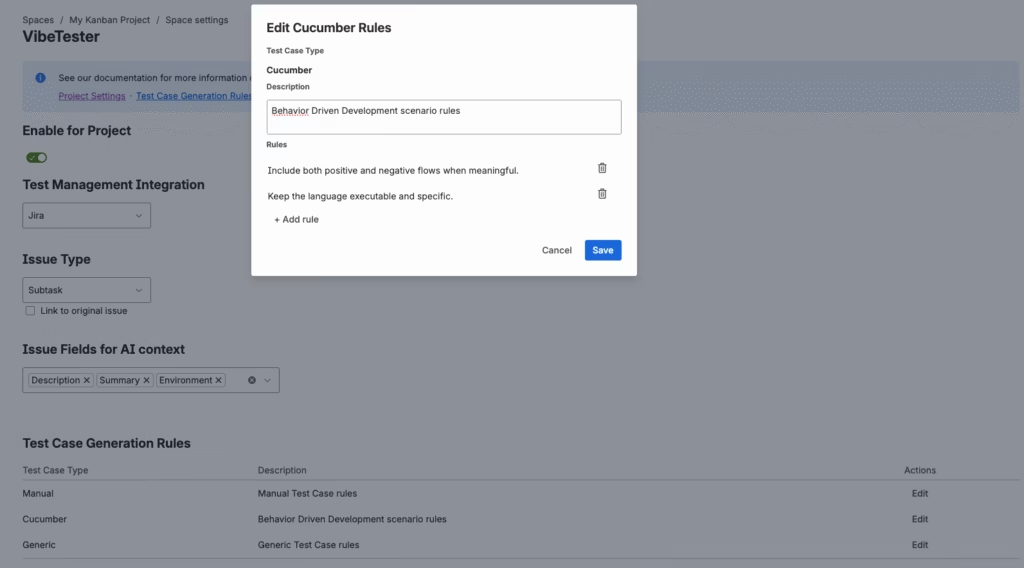
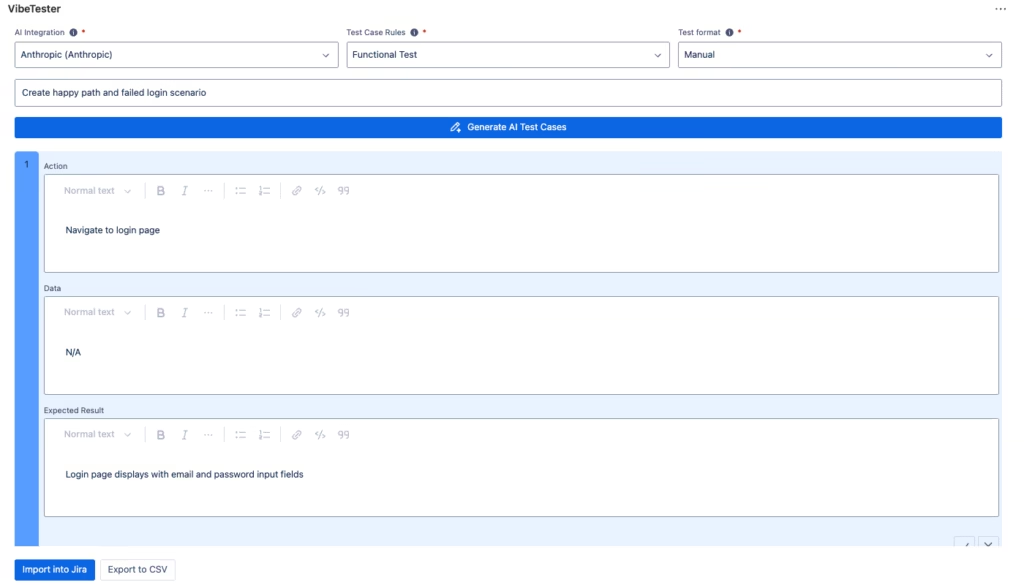
Once enabled, the next step takes place in the project settings. Here, teams can create project-level rules—templates that define how test cases should be shaped. These templates act as a framework rather than a fixed script: a senior tester can define what a good BDD scenario, manual test or generic test should contain, and the agentic model will structure its output accordingly.
Teams with no existing templates can use AssertThat’s built-in defaults, which produce high-quality results out of the box. Equally, teams with mature internal standards can tune VibeTester AI test case generator for Jira to mirror their existing practice.
Generating Test Cases from a Jira Issue
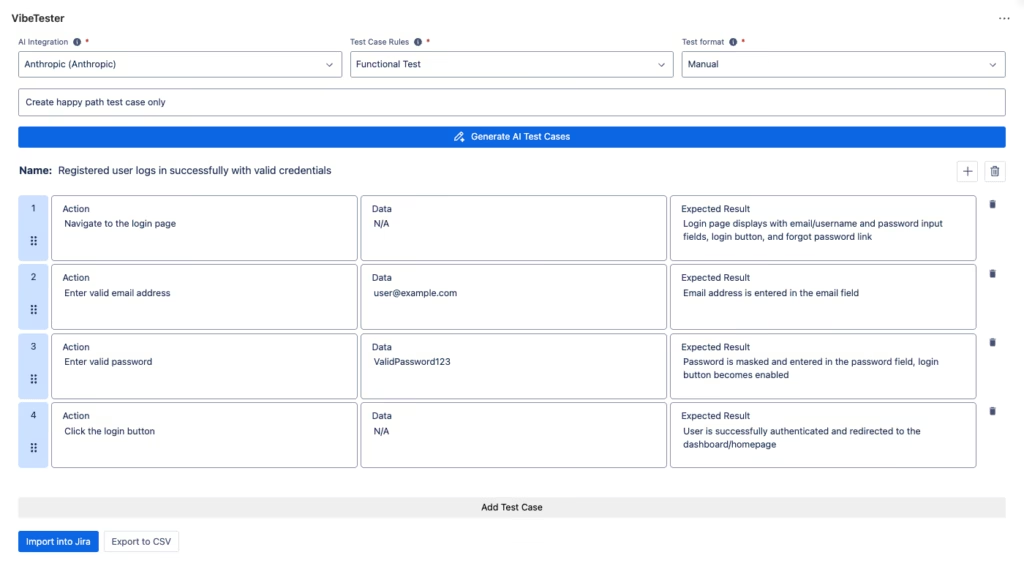
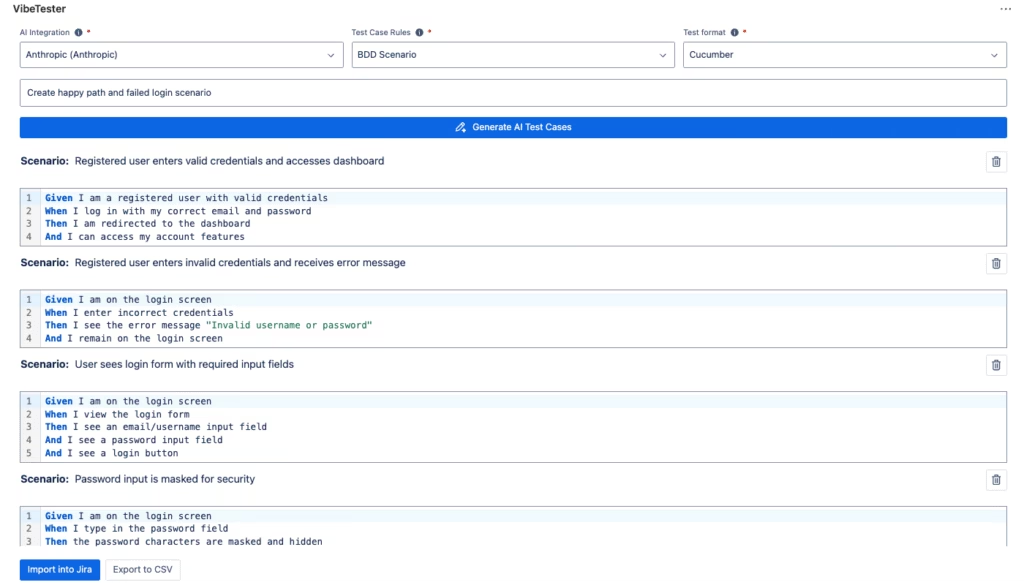
The main interaction happens in the Issue View. The tester opens a story or requirement and selects the fields they want to include—such as Summary, Description, Acceptance Criteria or custom-defined attributes. Additional context can be added where needed, including project notes or attached documents.
When the tester selects “Generate AI Test Cases”, the agentic workflow runs in sequence:
-
Authoring agent creates the initial scenarios.
-
Critique agent evaluates coverage, clarity and completeness.
-
Rewriter agent restructures and refines the final version.
The tester then receives a set of organised test cases or BDD scenarios within seconds.
Reviewing, Editing and Importing into Jira, Xray or Zephyr
Crucially, VibeTester keeps the tester firmly in control. Unlike tools that push generated content straight into the repository, VibeTester requires human review. Testers can edit, remove or expand scenarios before importing them.
Once approved, test cases can be:
-
Stored natively in Jira,
-
Imported as Xray Tests or Pre-Conditions,
-
Imported into Zephyr with the appropriate structure.
This safeguards test quality and prevents AI from producing an unmanageable suite.
Getting Started with VibeTester
For teams looking to modernise their testing practices, the most effective approach is to begin with a small, well-defined slice of work. VibeTester can be introduced gradually, allowing testers to build familiarity with the agentic workflow before expanding its use more widely. Most teams start by enabling the plug-in on a single project, selecting a handful of representative user stories and defining a modest set of test case rules.
From there, the workflow becomes straightforward. Testers generate initial drafts using the fields already present in the Jira issue and refine them as needed before import. The aim is not to replace existing processes overnight, but to reduce the manual effort involved in early test design and to improve the consistency of the resulting scenarios. As testers become more comfortable with the tool, the rules and templates can be extended to reflect the team’s preferred patterns for BDD, manual test cases or hybrid styles.
Teams working across multiple projects often find that VibeTester helps bring a level of standardisation that previously required significant coordination. Once a common set of rules is established, test case design becomes more repeatable regardless of who performs the work. This is particularly effective when onboarding new testers or working with vendor resources.
For organisations evaluating AI in quality engineering more broadly, VibeTester provides a contained and controlled way to begin. It keeps all activity inside Jira, respects existing governance models and supports both internal and external LLM providers. This allows teams to gain the practical benefits of AI-assisted test design without compromising security or operational discipline.
Getting started is simply a matter of installing the plug-in from the Atlassian Marketplace and enabling it for a project. A short pilot, ideally within an active sprint, is usually enough to demonstrate where the tool provides the most value. Once the team is comfortable, usage can expand naturally across the wider programme.
Next Steps
Organisations adopt new testing tools most effectively when they can explore them in their own context. If you’d like to evaluate VibeTester directly within your Jira environment, a free trial is available through the Atlassian Marketplace:
For teams that prefer a guided walkthrough or want to discuss how VibeTester fits into their existing testing approach, you can book a short demonstration with the AssertThat team here: