AI-driven BDD is increasingly being used by Agile teams to support the creation and maintenance of Behaviour-Driven Development scenarios.
AI is starting to play a role in how Agile teams create and maintain Behaviour-Driven Development (BDD) scenarios. Its value, however, is often misunderstood.
AI does not replace collaboration, product ownership, or decision-making. In modern BDD practices, AI works best as human-in-the-loop support — helping teams reduce manual effort while keeping ownership of behaviour firmly with the people responsible for delivery.
This article explains how AI supports BDD scenario creation and refinement, where it adds value, and why human review and validation remain essential.
Why BDD Becomes Difficult to Maintain
BDD relies on regular discussion and continuous refinement. As Agile delivery scales, this becomes harder to sustain.
Common challenges include:
-
Large numbers of scenarios across projects
-
Inconsistent structure and wording
-
Scenarios drifting out of date as requirements change
-
Limited time for ongoing refinement
At this point, BDD can start to feel like a maintenance burden rather than a collaboration aid. AI can help here — not by taking control, but by supporting teams in producing and maintaining scenarios more efficiently.
AI-Driven BDD and the Human-in-the-Loop
AI-driven BDD is not about automatically accepting generated scenarios. It is about assisting authors while keeping humans in control.
In practice, this means:
-
AI generates or suggests scenarios and steps
-
Humans review, validate, and adjust them
-
Behaviour is only accepted once it reflects real business intent
This human-in-the-loop approach ensures that AI accelerates BDD work without introducing risk or misunderstanding.
How AI Supports BDD Scenario Creation
Creating new features and scenarios
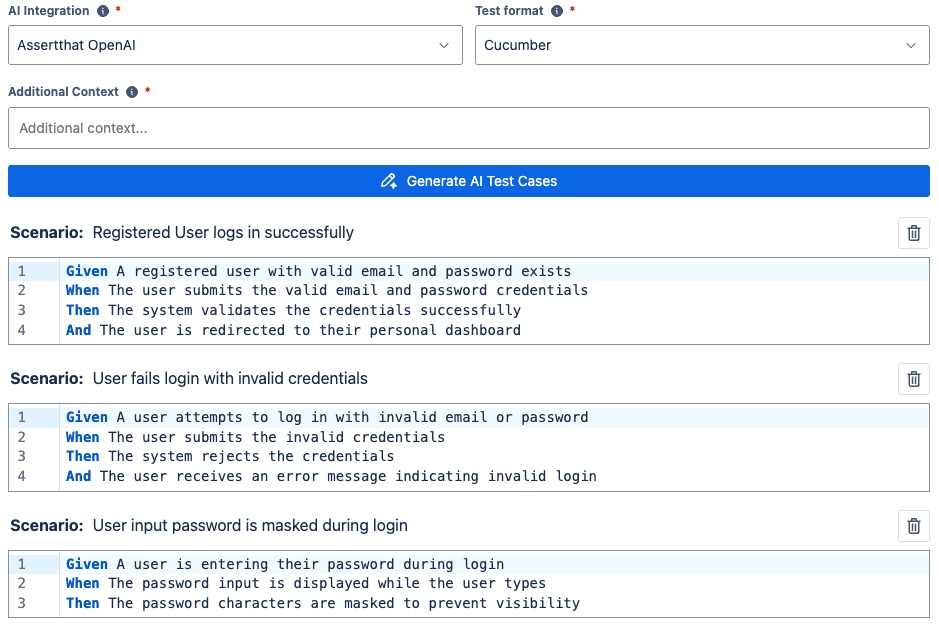
AI can generate complete BDD features and scenarios directly from Jira user story details. This gives teams a structured starting point during refinement, rather than beginning from a blank page.
These generated scenarios still require review, discussion, and validation by the team before they are considered correct.
Generating steps for existing scenarios
In some cases, teams may already have scenario titles or high-level descriptions. AI can support this by generating steps only, based on:
-
The scenario title
-
The user story description and context
This allows teams to control structure while using AI to accelerate step authoring.
Guiding Step Reuse Across the Project
As BDD adoption grows, step reuse becomes critical. Poor reuse leads to duplication, inconsistency, and maintenance overhead.
AI can assist by:
-
Referencing the existing library of steps used across the project
-
Suggesting steps that already exist before creating new ones
-
Encouraging consistent wording and behaviour reuse
This helps teams maintain cleaner, more maintainable BDD assets while avoiding unnecessary proliferation of similar steps.
Refinement, Consistency, and Coverage
Beyond initial creation, AI can support ongoing BDD maintenance by:
-
Improving clarity and readability of scenarios
-
Aligning scenarios with agreed formats and conventions
-
Highlighting duplicated or overlapping behaviour
-
Identifying potential gaps in behavioural coverage
These capabilities are most valuable when used iteratively, with humans validating and refining AI suggestions as part of normal Agile workflows.
What AI Cannot Replace
AI has clear limits, and recognising them is essential.
AI cannot:
-
Understand business priorities or context on its own
-
Decide which behaviour is correct
-
Resolve conflicting requirements
-
Replace conversations between stakeholders
BDD remains a human-centred practice. AI supports the mechanics, but people remain responsible for behaviour.
Using AI Responsibly in Agile Teams
Teams that gain value from AI-driven BDD tend to follow a few simple principles:
-
AI output is always reviewed by a human
-
Scenarios remain business-focused and readable
-
Ownership stays with product owners and delivery roles
-
AI is used to assist authoring, not bypass collaboration
When applied this way, AI becomes a practical accelerator rather than a source of risk.
Final Thoughts
AI does not change the fundamentals of Behaviour-Driven Development. BDD is still about shared understanding, collaboration, and clarity around behaviour.
What AI changes is the effort required to create and maintain BDD assets at scale. By supporting scenario creation, guiding step reuse, and assisting refinement — while keeping humans firmly in the loop — AI makes BDD more sustainable in Jira-based delivery environments.
Used thoughtfully, AI-driven BDD helps teams focus on the conversations that matter, while spending less time on repetitive authoring work.