BDD automation is often where expectations and reality start to drift apart.
Teams talk about “automating BDD” as if it is the goal in itself. In practice, automation is just one part of the picture. It’s useful only if it reinforces the behaviour that was agreed earlier — not if it quietly replaces it.
Automation sits after discovery and formulation. By the time scenarios are automated, the behaviour should already be clear. If automation becomes the place where behaviour is defined or corrected, something has gone wrong upstream.
This article looks at how BDD automation works in Jira-based teams, where it commonly breaks down, and how keeping automation results visible in Jira helps teams stay aligned.
Automation Is About Validation, Not Definition
A common mistake teams make is treating automation as the place where behaviour is nailed down.
In BDD, automation exists to validate behaviour that has already been agreed, not to define it. When scenarios are automated too early or without enough clarity, teams end up debugging intent rather than code.
Good BDD automation assumes:
-
the scenario already reflects agreed behaviour
-
the wording is stable enough to maintain
-
the expected outcome is unambiguous
When those conditions aren’t met, automation becomes brittle and expensive to maintain.
Where BDD Automation Commonly Breaks Down
Most automation issues aren’t technical — they’re organisational.
Typical problems include:
-
Scenarios automated without product or tester review
-
Automation living only in code repositories
-
Execution results visible only to engineers
-
Test reports disconnected from Jira stories
At that point, automation still runs, but its value is limited. Stakeholders can’t easily see what behaviour has been validated, and testers lose visibility into what has actually passed or failed.
Automation becomes something that “exists somewhere else”.
Why Automation Needs to Surface Back into Jira
Jira is where delivery decisions are made. If automation results don’t make it back there, they don’t inform those decisions.
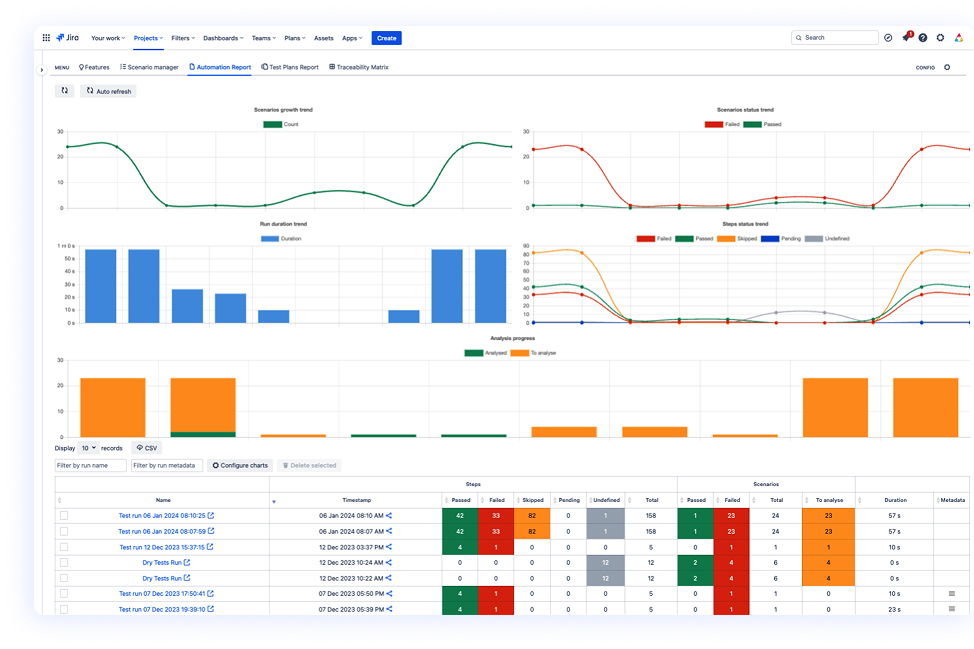
Bringing automation results into Jira allows teams to:
-
see execution status alongside the user story
-
understand which scenarios have passed or failed
-
avoid relying on external reports or screenshots
-
discuss failures in context, not in isolation
This is especially important for non-technical roles, who should not have to interpret CI logs or test framework output to understand delivery risk.
Automating BDD with Cucumber and AssertThat
AssertThat integrates with common BDD automation frameworks, including Cucumber, allowing teams to connect automated execution back to their scenarios in Jira.
In practice, this means:
-
Scenarios are written and managed in Jira
-
Automation executes as part of CI/CD pipelines
-
Results are imported back into Jira
-
Execution status is visible where the work is tracked
Automation doesn’t replace Jira — it feeds it.
CI/CD Integration Without Losing Visibility
CI/CD pipelines are designed for speed and reliability. They are not designed for collaboration.
AssertThat bridges that gap by:
-
accepting automated execution results from CI/CD pipelines
-
mapping those results back to the relevant BDD scenarios
-
displaying pass/fail status directly in Jira
This keeps automation fast while making outcomes visible to the wider team.
Teams no longer need to answer questions like:
-
“Did this scenario actually run?”
-
“Which behaviour failed?”
-
“Is this a test issue or a requirement issue?”
The answers are visible in the same place where the work is discussed.
Automation at Scale
As projects grow, automation scales faster than understanding.
Large test suites can run thousands of scenarios in minutes, but without clear visibility, that speed doesn’t translate into confidence. Teams need to know what has been validated, not just that tests ran.
By keeping automated BDD results linked to scenarios and stories in Jira, teams can:
-
assess coverage more easily
-
spot gaps in validation
-
avoid automating behaviour that is no longer relevant
Automation remains aligned with delivery intent rather than drifting into a separate activity.
Final Thoughts
BDD automation is valuable, but only when it stays connected to the behaviour it is meant to validate.
Treating automation as part of the Jira workflow — rather than something that lives solely in CI pipelines or repositories — keeps it grounded in delivery reality. It improves visibility, supports better conversations, and helps teams trust what their automated tests are actually telling them.
Automation should support understanding, not replace it.